
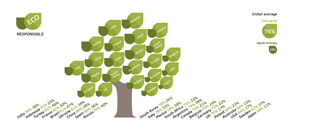
 Close to two thirds feel guilty when they do something that is not environmentally friendly.
The same number claims to only buy products and services that appeal to their beliefs, values or ideals.
With the 45th World Earth Day happening this week, GfK has published survey findings showing how important environmental values are to people internationally.
GfK asked over 28,000 people aged 15 or older across 23 countries about how strongly they agree with specific statements. Over three quarters (76 percent) agree that brands and companies have to be environmentally responsible, while just short of two thirds (63 percent) say they feel guilty when they do something that is not environmentally friendly and only buy products and services that appeal to their beliefs, values or ideals.
This is in sharp contrast to the few who disagree with these statements. Only six percent feel that brands do not have to be environmentally responsible, 14 percent do not feel guilty when they do something that is not environmentally friendly and 11 percent indicate that they do not only buy products and services that appeal to their beliefs.
With so much competition for consumers’ money, everything that brands can do to align with their customers will help them stand out and win loyalty. Consumers want to feel good about whom they spend their money with – and these findings indicate one way that brands can tune in to that desire.
Brands have to be environmentally responsible
Internationally, over three quarters of women (78 percent) and exactly three quarters of men (75 percent) agree that brands and companies have to be environmentally responsible. This includes close to three in ten (28 percent) who say they agree strongly with that statement, with women again being slightly ahead of men at 29 percent versus 26 percent.
When it comes to different age groups, there is a fairly even distribution of those in overall agreement, with the 30-39 year olds slightly ahead at 80 percent, followed by 40-49 year olds (78 percent) and those aged 60 and over (77 percent). The youngest age group (15-19 year olds) boast over two thirds (69 percent) agreeing with the statement – so, although they come behind the other age groups, a clear majority is still saying that brands and companies have to be environmentally responsible. The age groups that show the highest numbers saying that they agree strongly with this statement, however, are the 50-59 (31 percent) and 40-49 year olds (30 percent).
Looking at individual countries, consumers in India and Indonesia express the highest overall agreement with this statement (94 and 93 percent respectively). And even in those countries with the lowest levels of agreement – Japan at 58 percent and Sweden at 62 percent – we are still seeing well over half of their consumers backing this statement. The countries that show the greatest intensity of support (those agreeing strongly that brands have to be environmentally responsible) are Brazil with 47 percent, Turkey with 46 percent and Russia with 40 percent of consumers.
Feeling guilty
On the question of personal responsibility, nearly two thirds (63 percent) of consumers internationally say they feel guilty when they do something that is not environmentally friendly – including 17 percent who agree strongly that that is the case. This is again slightly led by women, at 64 percent agreeing in total and 18 percent agreeing strongly, compared to men at 61 percent in total and 15 percent agreeing strongly.
The breakdown by age groups shows a very even spread, ranging from 58 percent of those aged 50 and over agreeing that they feel guilty when they do something that is not environmentally friendly, up to 65 percent of all those aged 20-39. A point to note is that 15-19 year olds show the highest percentage strongly agreeing that they personally feel guilty when they do something that is not environmentally friendly (18 percent). This indicates greater awareness amongst teenagers than previous generations that protecting the environment is a personal responsibility.
When it comes to countries, India and Indonesia again lead for numbers feeling guilty when they do something not environmentally sound, standing at 85 and 83 percent respectively – while South Korea (41 percent), Poland (38 percent) and Sweden (37 percent) bring up the rear. But it is in India and Brazil (both 35 percent) where we see the greatest percentage of people giving the strongest agreement about green guilt.
Only buy things that appeal to beliefs
Men and women are absolutely level (63 percent each) in agreeing that they only buy products and services that appeal to their beliefs, values or ideals. But women are slightly more likely to say they agree strongly with this statement, at 17 percent compared to men’s 15 percent.
The split across age groups is slightly more varied, with around two thirds of 30-39 year olds (68 percent) and 20-29 year olds (65 percent) agreeing overall, compared to 57 percent of 15-19 year olds and those aged 60 or over. When it comes to giving strong agreement that they only buy products and services that appeal to their beliefs, the 40-49 year olds take the lead with 18 percent, compared to all the other age groups with 15 percent each.
The breakdown by countries yet again shows India and Indonesia in the lead – but this time India is well ahead, with 94 percent agreeing overall while Indonesia follows with 78 percent, equal with Ukraine. India also has significantly higher percentage agreeing strongly that they only buy products and services that appeal to their beliefs, standing at 47 percent, compared to the next closest country, South Africa, at 31 percent.