

 Global perceptions of private-label products have proven to be largely favorable, with almost three-quarters of global respondents (71%) in a recent Nielsen online survey saying that private-label quality has improved over time. Similarly, 67% believe private label offers extremely good value for money, and 62% say buying private label makes them feel like a smart shopper. Despite these positive perceptions, private label growth is still nascent in many developing countries, where name-brand loyalty remains very strong.
AFRICA AND THE MIDDLE EAST: IN THE EARLY START-UP PHASE
With the exception of South Africa, private-label development is still in its infancy in the Middle East/Africa. While private label represents 18% of dollar sales in South Africa, it is 1% or less in all Middle Eastern countries in the study.
Given its relatively low penetration, what does the future hold for private label in the Middle East/Africa? While Nielsen expects further private-label growth, brands will likely continue to dominate in the Middle East/Africa for the near future.
Private-label growth is heavily dependent on the spread of modern trade, which has low penetration and is primarily available in urban areas only. Even in South Africa—the biggest private label market in the region—30% of sales still come from traditional trade. Also key will be retailers’ ability to create a consistent source of manufacturing expertise and supply for private-label brands. This has been a significant hurdle in the region, as many have struggled to find local suppliers able to match the quality of multinational fast-moving consumer goods manufacturers.
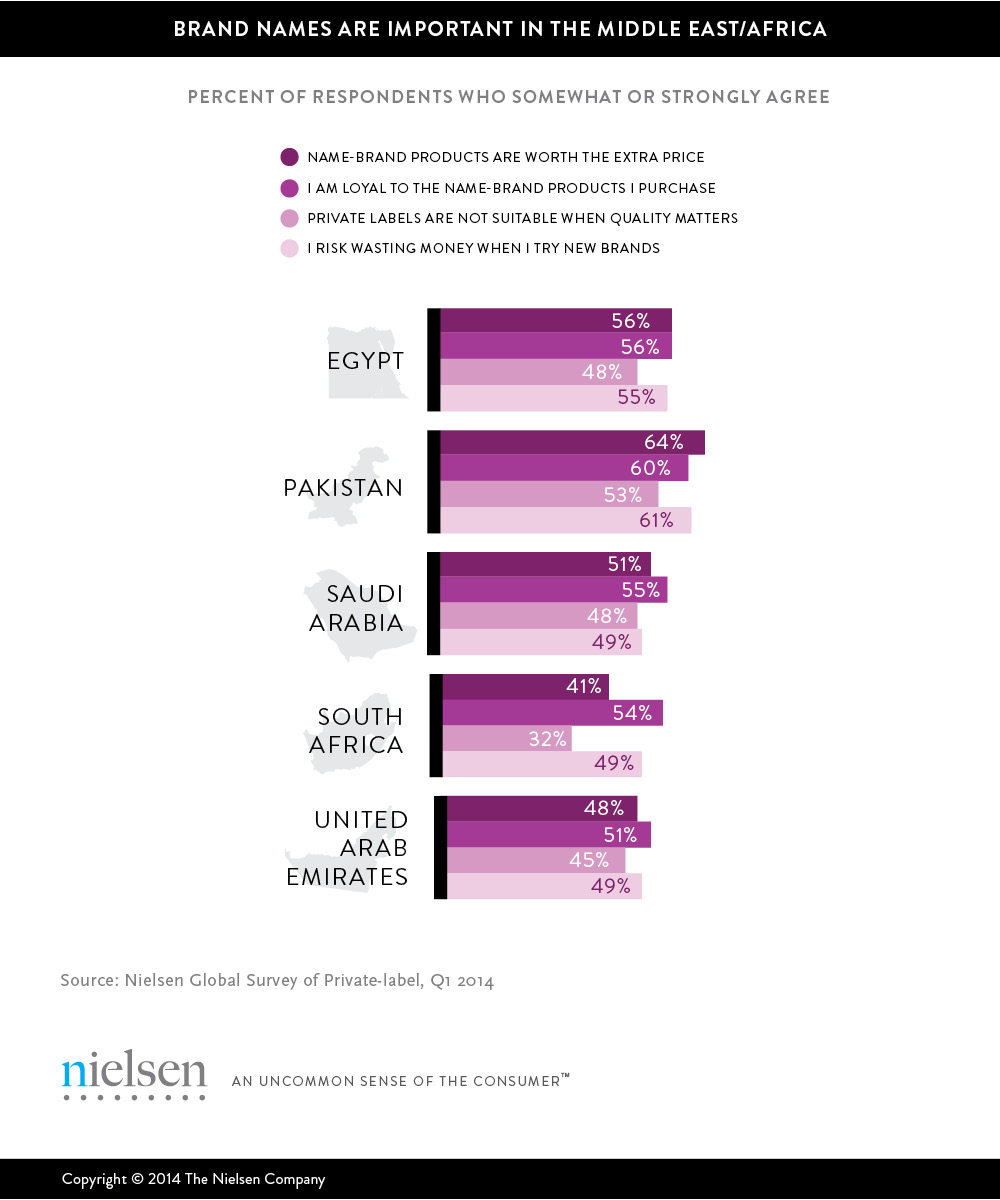
Retailers must also overcome strong brand loyalty and uncertainty about quality. Brands have a long legacy in this region while private label has struggled with low awareness and trust. Purchasing an unfamiliar product is inherently risky, and many consumers don’t have the disposable income necessary to take a chance on a product that might not deliver. Fifty-five percent of respondents agree they risk wasting money when they try new brands—the highest percentage of all regions.
Name brands are familiar and provide an assurance of quality; as a result, they generate significant loyalty. Indeed, 57% of Africa/Middle East respondents say they’re loyal to name-brand products, compared to 50% globally. As in Asia, poor quality perceptions and strong brand loyalty can pose significant barriers to private-label growth. Therefore, retailers will need to invest in campaigns to increase comfort with store-brand offerings.
ASIA: BRAND LOYALTY REIGNS IN THIS DIVERSE RETAIL LANDSCAPE
Modern trade and private label are not new concepts in Asia—they have been around for the last quarter century. In fact, 90% of urban Thai shoppers regularly use large format hypermarkets, and 65% use them as their main grocery outlet. Despite this, private-label dollar share has increased only slightly in the last decade and has actually regressed for the past few years, as name brands have increased their promotional activity.
Why has private-label growth been so slow? In short, Asian shoppers are strongly brand-loyal, and retailers have not invested enough in marketing private label to persuade shoppers to trust its quality. Asia-Pacific has the highest percentage of respondents (58%) who believe name brands are worth the extra price—a level that’s 10% higher than the global average, 20% higher than North America and 26% higher than Europe. Additionally, the prospect of purchasing an untrusted store-brand product becomes particularly difficult for lower income shoppers with limited disposable income. Nearly six out of 10 respondents in Indonesia (59%), the Philippines (58%) and Thailand (56%) believe they risk wasting money when they try new brands. Instead, shoppers prefer to buy the trusted brand advertised on TV every week, especially now that it is increasingly offered at a discounted price.
“Retailers launched private-label programs expecting Asian consumers to instantly trust them without investing the 20 years it has taken in developed markets to build acceptance,” said Peter Gale, managing director of retailer services, Nielsen. “Many Asian retailers virtually copy-and-pasted the European model without dedicating the groundwork necessary. Just launching new private-label products is not going to drive significant growth unless retailers address the fundamental issue of shopper demand properly.”
<