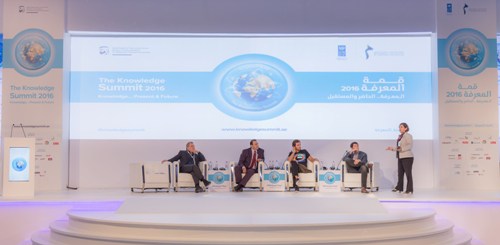
 Is the media making the future, or is the future making a new form of media? That was the key question posed to panellists on a media-focussed session at the third annual Knowledge Summit, organised by the Mohammed bin Rashid Al Maktoum Foundation (MBRF) – member of the Mohammed bin Rashid Al Maktoum Global Initiatives – held in Dubai from December 5-7 at the Grand Hyatt.
Titled Media and Making the Future, the session was moderated by Caroline Faraj,
Vice President of Arabic Services, CNN, and comprised personalities from both traditional media and new media. Opening the spirited debate, Ali M. Jaber, Dean of the Mohammed Bin Rashid School For Communication of the American University in Dubai and Group TV Director, MBC said: “Technology has transformed how we learn, how we do things, how we discover. But change is so fast, adapting won’t easy, and won’t be enough.”
He was especially concerned about how news consumption was being affected. “Journalism is a process – you search for your story, then you fact check and fact check and fact check, and they write the story. The problem today is that fact checking has been removed from the process. So the question is: how do we fortify our journalists against the hatred spread across new media?”
Jason Silva, the Emmy-nominated host of National Geographic Channel’s Brain Games, and creator of the web series Shots of Awe, agreed that the “filter bubble effect” was a serious issue facing media. “Social media democracy has become a double-edged sword,” he said. “Through the filter bubble – through clicks and algorithms – new media becomes a ‘reality tunnel’, reinforcing your own worst views, and warping your view of the world.”
Brandon Stanton, the photographer and creator of the popular website HONY (Humans of New York), said that social media was failing to live up to earlier Utopian ideals. “I grew up when Facebook was just getting big,” he said. “I had this thought that it was going to connect everyone, encourage empathy. We would be unable to be divided anymore – technology would outpace tribalism.
“It’s sad that this dream is now in question. Social media has been used to spread the worst of ourselves. Ten years from now, I don’t think morality will keep pace. The revolution in consciousness won’t keep pace with the revolution in technology.”
Riz Khan, the television reporter for BCC, CNN and Al Jazeera, said: “Technology has outpaced ethics. At CNN, At the BBC at Al Jazeera, of course people came with their own biases. People bring baggage. The trouble is with information that is unfiltered. My father used to say of something he was sure of that he’d ‘read it in the newspapers.’ But of course, newspapers back then filtered news through trained journalists. Now it is: ‘it must be true, I saw it on the Internet.’ Unless people educate themselves on how to filter this, it’s a problem.”
Silva, however, said he was more hopeful that new technology could directly challenge our inherent biases. He cited a virtual reality film made for the UN, shot from the point of view of a Syrian in a refugee camp. “Virtual reality radically disrupts our experience of the self,” he said. “It could give people an experience of the ‘other’.”
Stanton admitted that by operating as a ‘one man band’ he bypassed the traditional editorial checks and balances, but believed he was up to the task of imposing ethics on his work. He said that through technology, he had no need to go through traditional training in order to achieve what he wanted: telling people’s stories.
Also addressing fact-checking, Jason admitted his films were primarily entertainment, not academic treaties, but said they were “packed with quotes and citations”. “I’m not pretending to be the BBC,” he said. “But I am making a film to make you think or dig deeper.”
Al Jaber agrees education is needed: “Our students should be grounded in philosophical works, rather than learning how to master a piece of technology in five years,” he said saying that they need to understands the ethics of what they are doing before rolling out transformational technologies.”
Asked whether the UAE, and the Arab world as a whole, was keeping pace with the changes in media, Al Jaber was pessimistic. “Dubai – the UAE – is a utopia,” he said. “But the UAE is not the Arab world. I am pessimistic about the way forward. To do what humans of New York is doing you need infrastructure, and you need human development. You need the luxury of thinking about things other than day-to-day challenges.”
Khan agreed that the UAE was unique, but while other parts of the region lacked infrastructure, human nature being human nature meant everyone would seek greater connectedness.
Stanton said that the main takeaway the region could take from his success was to look outward and not inward. “Social media is all about ‘Me! Me! Me!’” he said. “I used social media to document other people. So I say, ‘quit telling your own story’. Humans of New York is one of the largest, most engaged blogs in the world – and the more I remove myself from the story, the faster it has grown.”
In terms of the media we consume, the panellists agrees the future was shaping up to be more and more visual. “When I travel by train, or by plane, I used to read a book,” Al Jaber said. “Now I watch television shows. Visual has taken over from conversation & reading.”
Khan agreed, adding that the once separate processes of writing for radio, TV and print or online had now merged into one – a move he lamented as a step backwards. “This merging means skills, language and understanding are being lost,” he said. He also mourned the loss of finding surprising articles while browsing printed newspapers and magazines.
Stanton, though, whose blog features a photographs of individuals with accompanying stories, believes well-told stories would always be supreme. “The story is far more important than the photograph,” he said. “I could take a bad, out-of-focus story, but if the accompanying story is compelling, it will be shared 100,000 times. A perfect photo – if the story isn’t good – will fail.”
Jason agreed that compelling content will always be crucial for the future of media, but, as more and more decisions on what to watch are delegated to consumers, what that content is harder to guess. “My most successful video is a badly shot, upright clip taken on an iPhone – me talking to a baby. It’s had 100 million views, it really went viral. I’ve shot films costing hundreds of thousands of dollars with NatGeo, which have not connected at all.”